Every Durga Puja, Kolkata turns itself inside out. Lanes become galleries, bamboo, cloth and clay become architecture, and neighbourhood clubs become patrons, curators and stagehands all at once. Recognised by UNESCO as an Intangible Cultural Heritage of Humanity, Durga Puja has long transcended the boundaries of a traditional religious festival, evolving into one of the world’s most dynamic open-air art and cultural celebrations.
In 2026, mandaps across Kolkata showcased an extraordinary range of artistic expression and conceptual storytelling. They drew inspiration from Bengal’s most illustrious polymaths, the lives of coal miners, memories of the freedom struggle, and the fragility of the environment. What set the most compelling installations apart was not their size or sparkle, but the conviction behind them. Terracotta, oil barrels, woven fibres and folded paper became more than decorative elements; each material carried an idea, an argument or a story. And through it all, Devi remained the cynosure.
We chose the five mandaps featured here for the strength of the ideas they brought to life. Each invites you to slow down, look closer, and step beyond the spectacle.
Come, walk in with us.
Nirmaan… Bi-nirmaan: A Symphony of Steel, Rubble and Memories
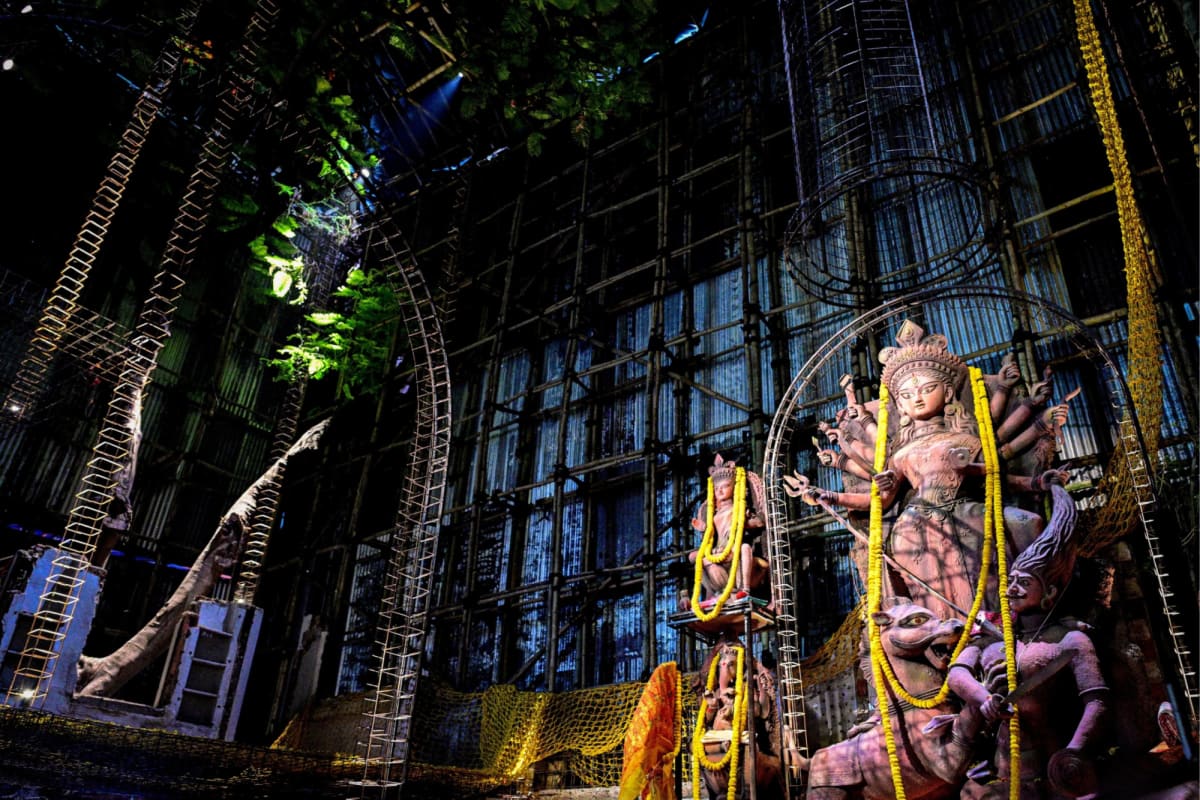
You step into a narrow lane that doesn’t look like a mandap entrance. Rust-brown steel poles rise on either side, corrugated tin sheets lean against one another, and overhead, a lattice of framework lets the diffused October light filter through in thin squares. Your first impression is of a place under construction, or perhaps one that has just been taken apart. Further in, the tin walls fall away, and the space opens into something unfinished.
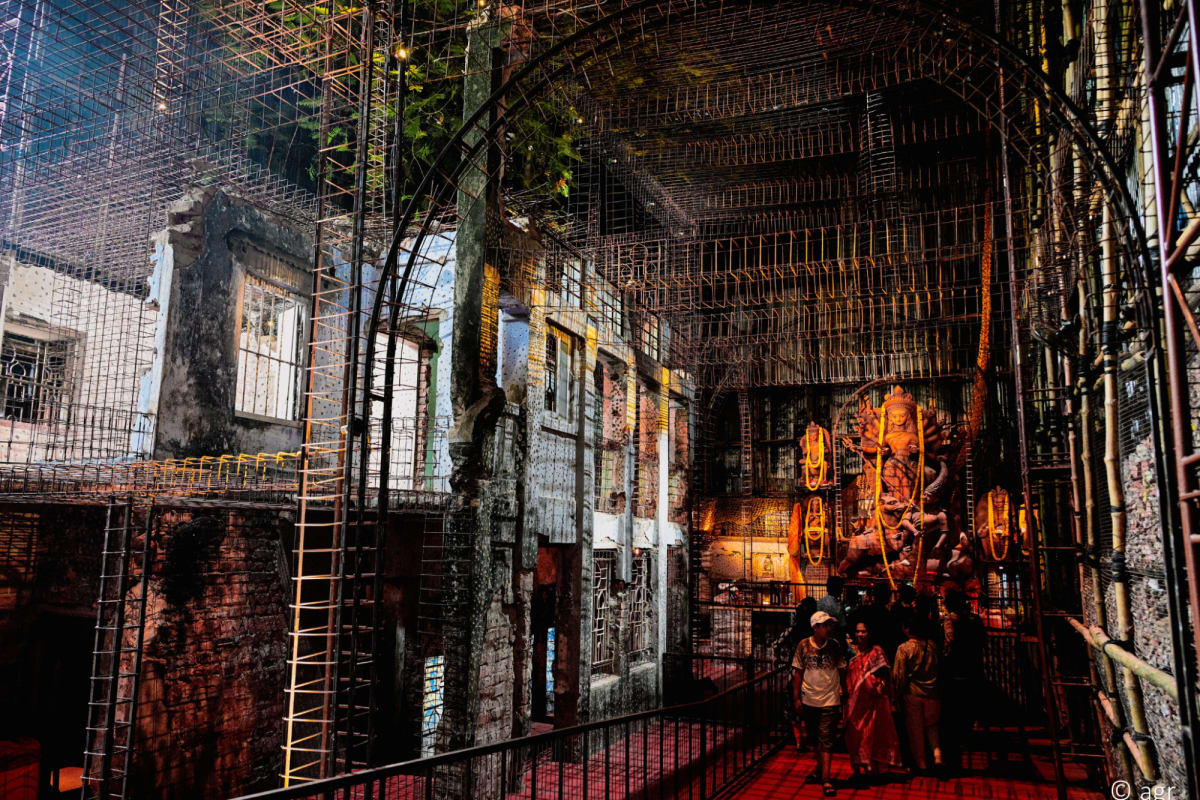
The atmosphere strips away the usual opulence of Durga Puja, replacing it with something understated and deeply reflective. You find yourself walking through the skeletal remains and rising scaffolding of a changing cityscape. Crushed brick, stone aggregate, and rubble line the base of the installation. In a striking detail, living trees break through sliced walls and metal grids, reminding us that nature continually reclaims what human hands build and tear down.
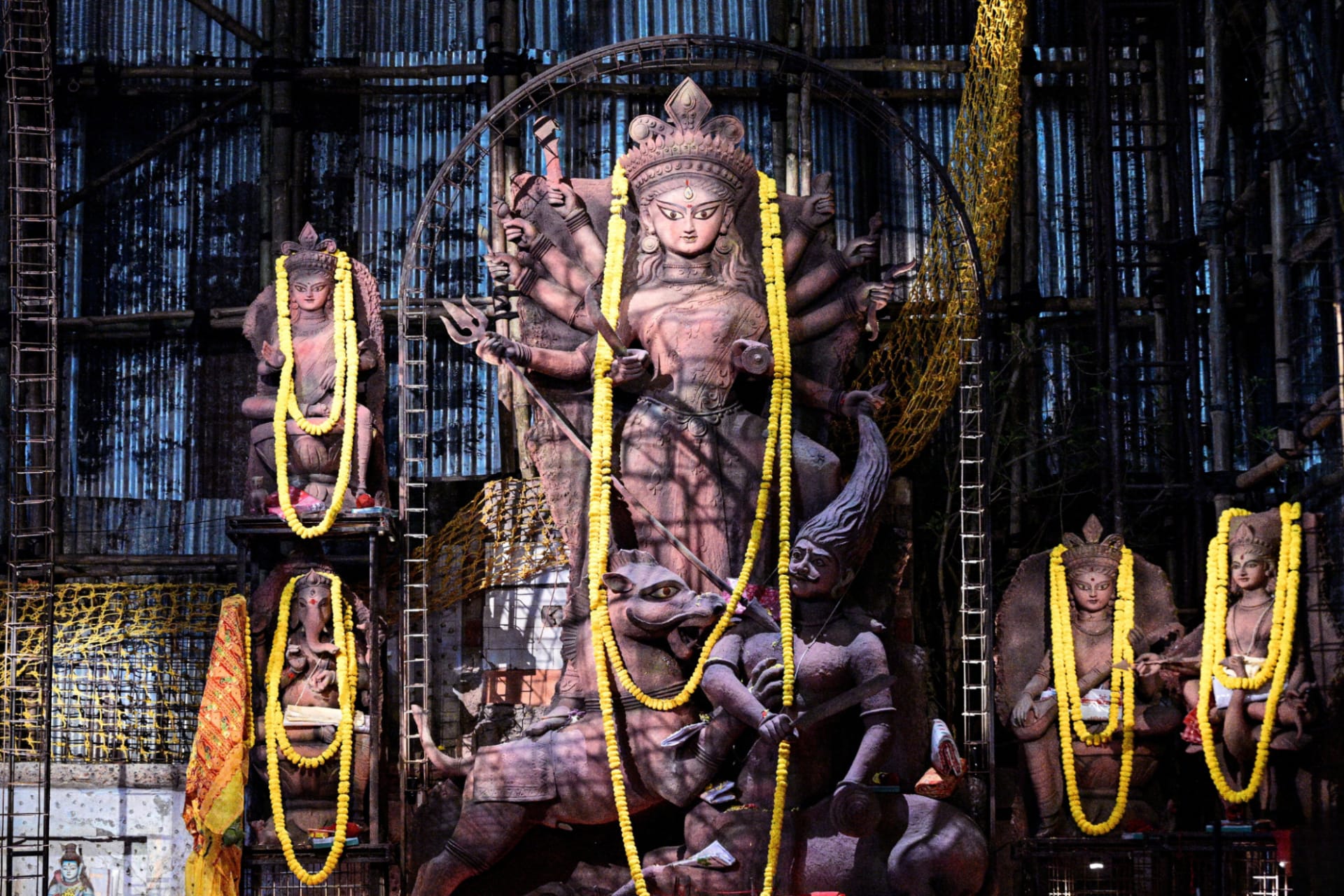
Walking through the installation, you can’t help but reflect on how a city is shaped as much by what it discards as by what it builds. Then the walkway turns, and Devi appears. Sculpted in unglazed terracotta with raw, stone-like textures, the idol seems to have risen from the same earth as the ruins around her. A slender steel arch frames her like a halo, evoking a sense of divine permanence in an impermanent, ever-evolving world.
Tel – The Market of Faith: A Greasy, Glorious Ode to Oil
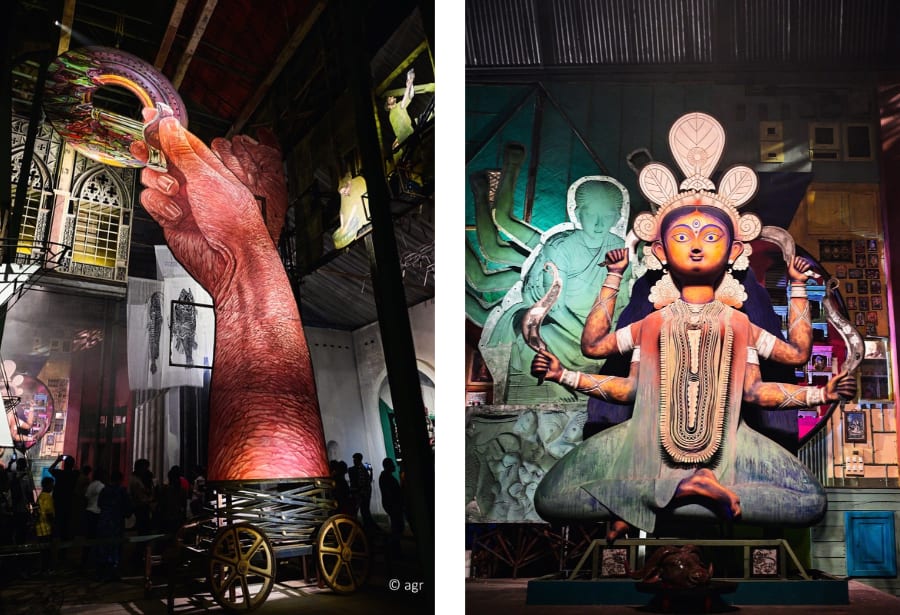
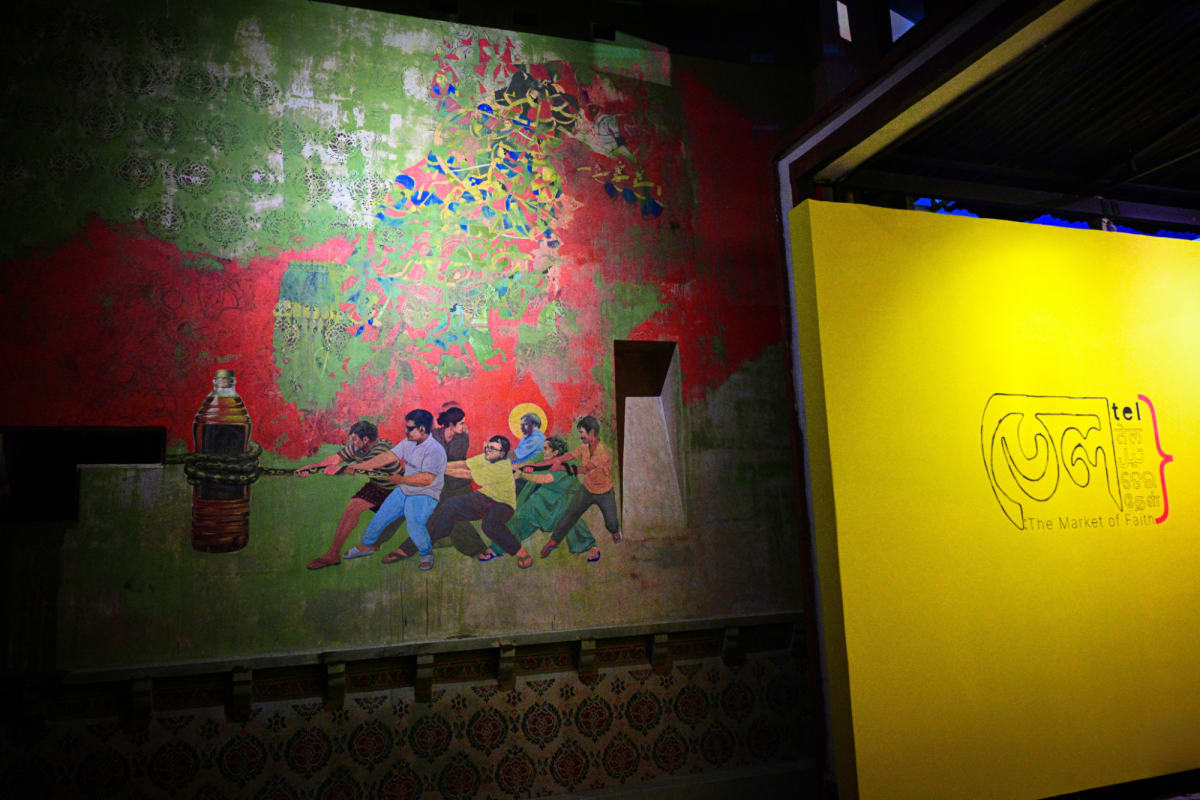
Entering the pavilion feels less like stepping into a traditional festive space and more like descending into a living, breathing canvas of sociopolitical commentary. The artist builds a layered universe around a simple yet ubiquitous element of everyday Bengali life — tel (oil). In the outer precinct, striking, symbolic murals introduce the theme.
Inside, towering arches fashioned from stacked oil barrels curve overhead, drawing your gaze into a cavernous visual maze. Architectural facades featuring Gothic windows, ornate Arabic jaali, calligraphed doors and weathered plasterwork blend seamlessly with stark industrial motifs. Oil has carried different meanings across centuries, and this visual collage suggests that it is as much about memory, hunger, labour and household economies as it is about commerce. Temple-inspired reliefs on a red pillar add to the sense of a marketplace of faiths. Everything here is bought, sold, anointed and fought over; every belief, it seems, has its own relationship with oil.
At the centre of this visual cacophony, Devi appears almost meditative. Her form is restrained and graphic, marked by a tall, leaf-shaped crown, layered necklaces and bangles in white, and delicate patterns against warm, earthy skin. Her adornments rely on muted colours and raw textures, lending the idol a quiet, almost folk-art sensibility. It is a moment of stillness at the heart of the noise.
Nishaan: Where Skin Becomes Scripture
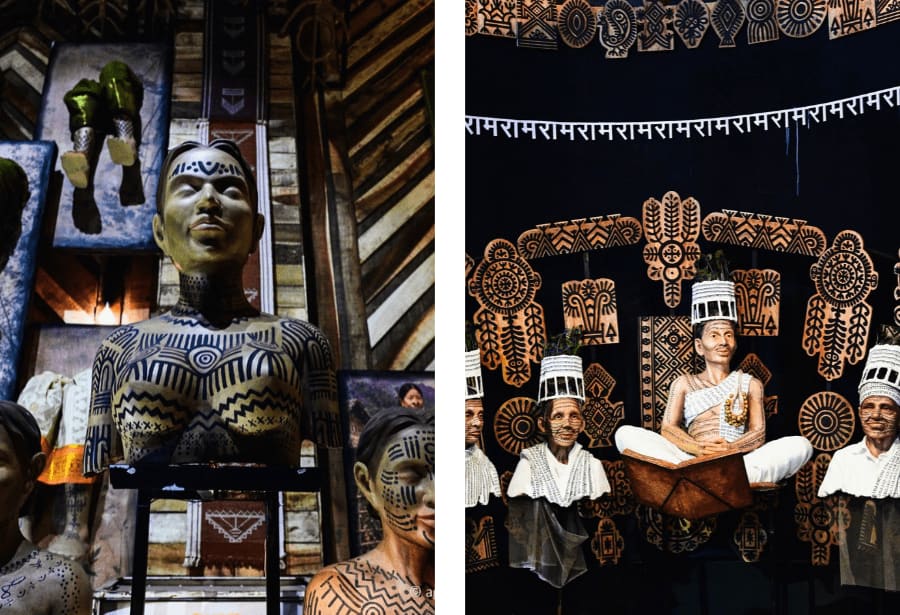
Nishaan means mark, sign or imprint. The theme draws on the Ramnami Samaj, a community in Chhattisgarh whose members tattoo the name of Ram across their bodies, including their faces and eyelids. This practice is both an act of devotion and a quiet assertion of identity in the face of caste-based exclusion from temples. The designer builds the experience around a powerful idea: if you are denied entry to a temple, you become the temple itself.
The entrance façade greets visitors with charred wooden panels. Suspended above the central pathway is a stylised cradle made from woven strips and natural fibres, evoking journeys, passage and communal roots. Busts bearing geometric tribal tattoos, known as Godna, stand tall, celebrating identities inscribed onto the skin. The imagery stays with you precisely because it is so understated.
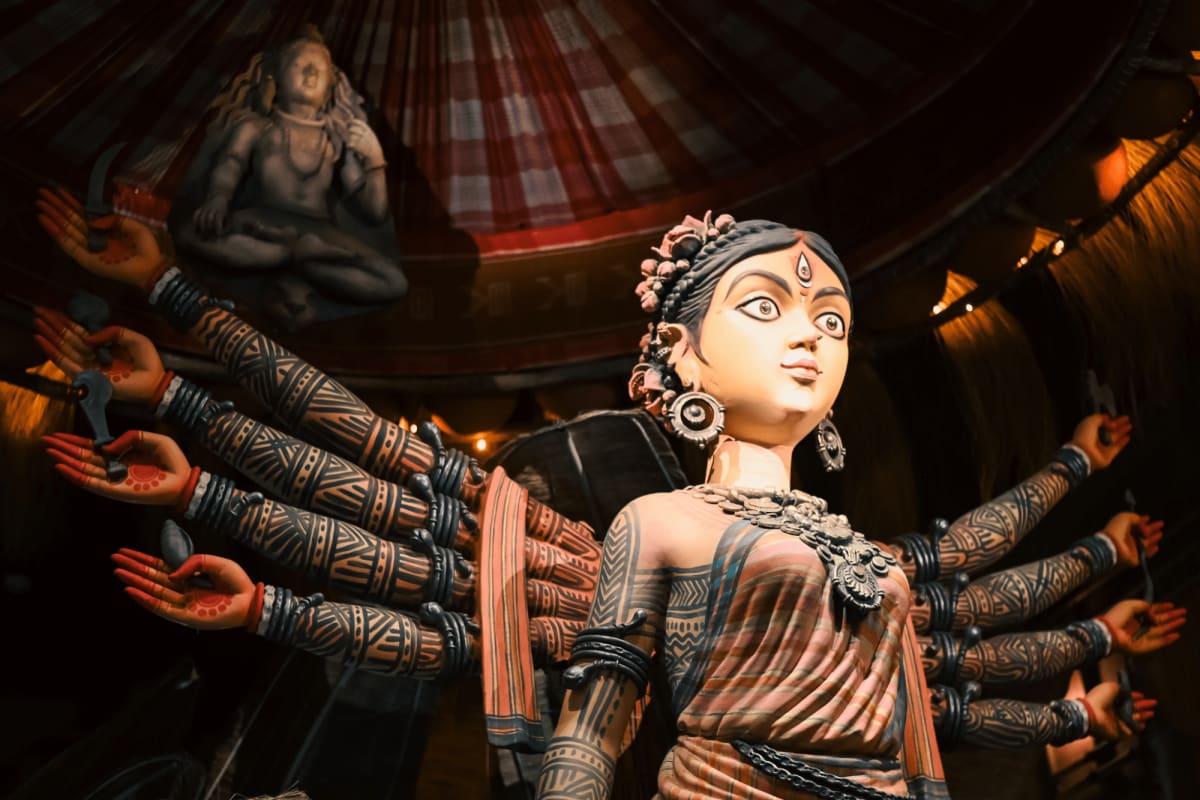
Draped in soft pastel and terracotta handloom textures, the Goddess moves away from metallic shimmer in favour of an organic grace. Delicate woven borders, a minimalist interpretation of the traditional atpoure cotton sari, understated neckpieces and intricate hand-drawn facial markings lend her an aesthetic that balances regal strength with a quiet sense of rootedness.
The design works because everything feels tactile and considered. There is no plastic sheen or ornamental excess; the message is conveyed through materials, textures and the stories they hold. Devotion does not always need a temple. Sometimes, it is inscribed on the skin and carried for life.
Elem Notun Deshey: A Realm of Cards
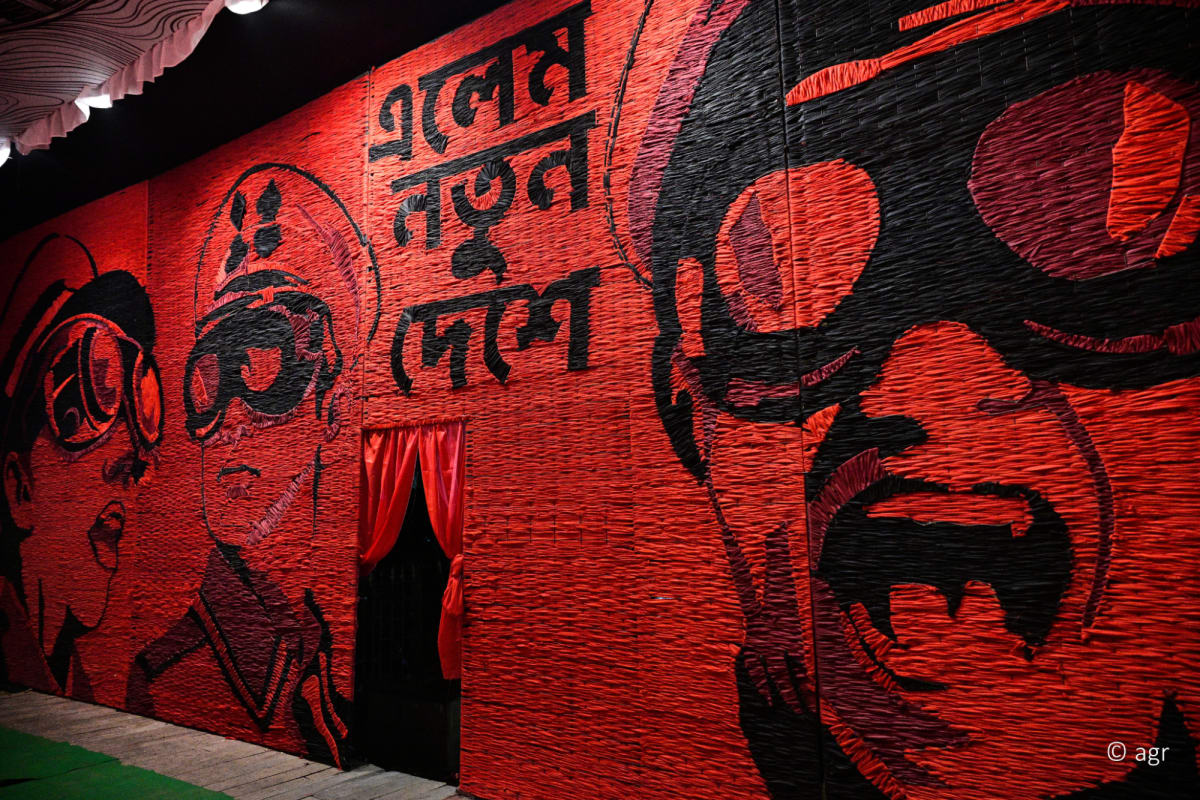
Step into the mandap, and you are transported into a world where allegory, bold graphic design and raw human expression converge. The concept draws on Rabindranath Tagore’s iconic dance drama, Tasher Desh (The Kingdom of Cards), exploring the liberation of the human spirit from rigid social structures, dogma and artificial boundaries. The journey begins at the entrance, where a striking mural woven with red threads sets a dramatic tone.
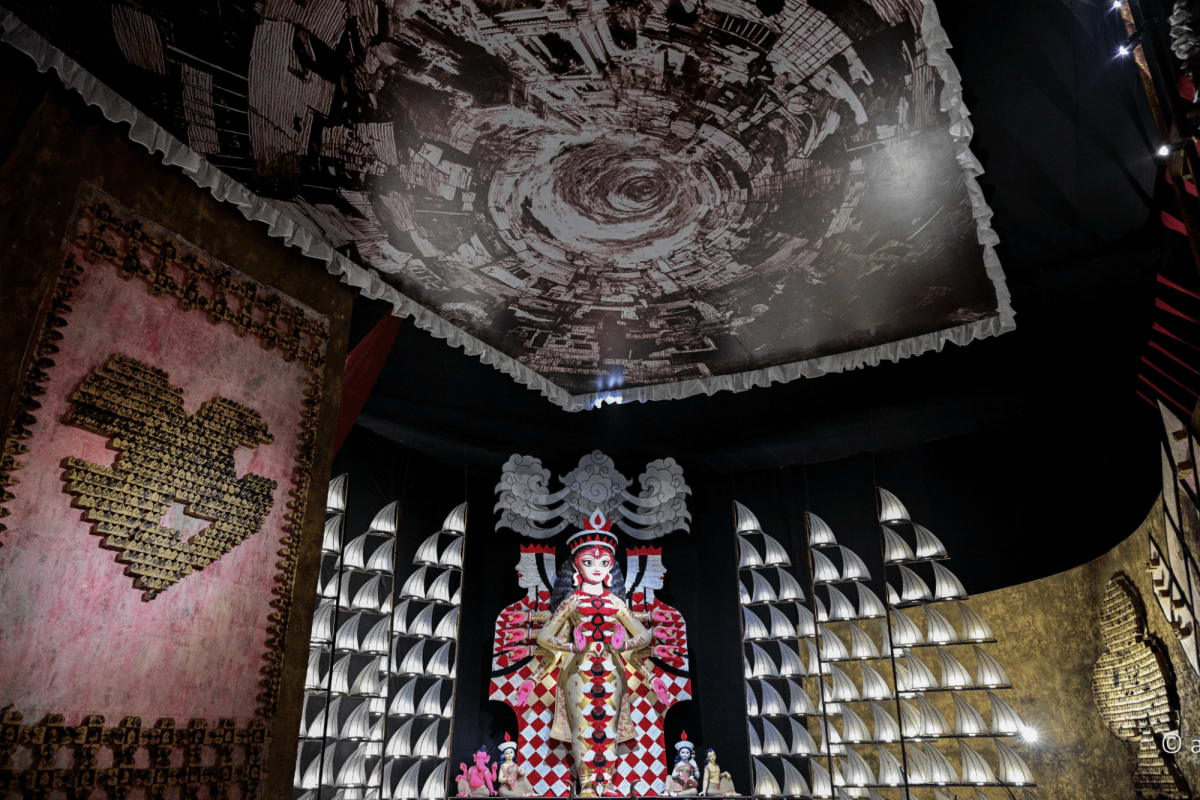
Moving inward, the space unfolds into a more immersive installation. Intricately crafted three-dimensional card suits dominate the walls, fashioned from folded paper, clay tiles, and wooden blocks to represent the rigid rules and structures of society. Translucent, illuminated sails line the corridors, creating a hauntingly beautiful atmosphere, as though you are embarking on a voyage into an uncharted world.
Beyond the corridors, Devi emerges as a figure of stillness. She stands upright, facing forward, her palms raised in blessing, against a woven red-and-white chequerboard backdrop that echoes the geometry of a card table. The contrast between the installation’s dynamic visual language and the Goddess’s composed presence lends the space its contemplative quality. It is a striking exercise in conceptual art, making this one of the festival’s most thought-provoking visual experiences.
Kaal Dhwani: The Visual Depiction of Time
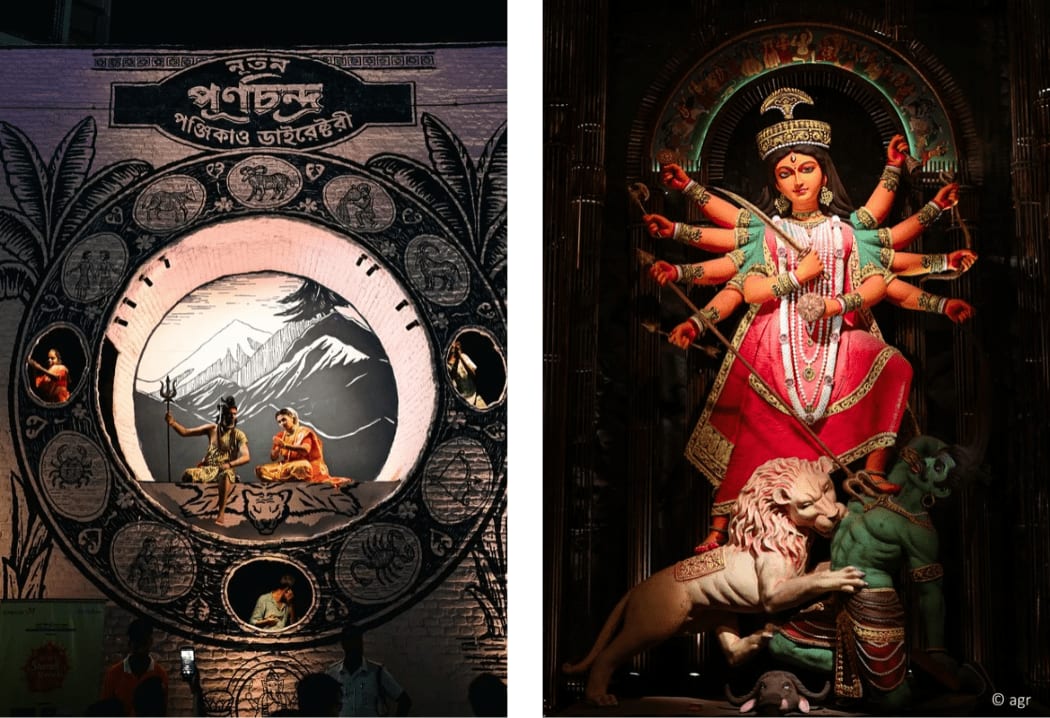
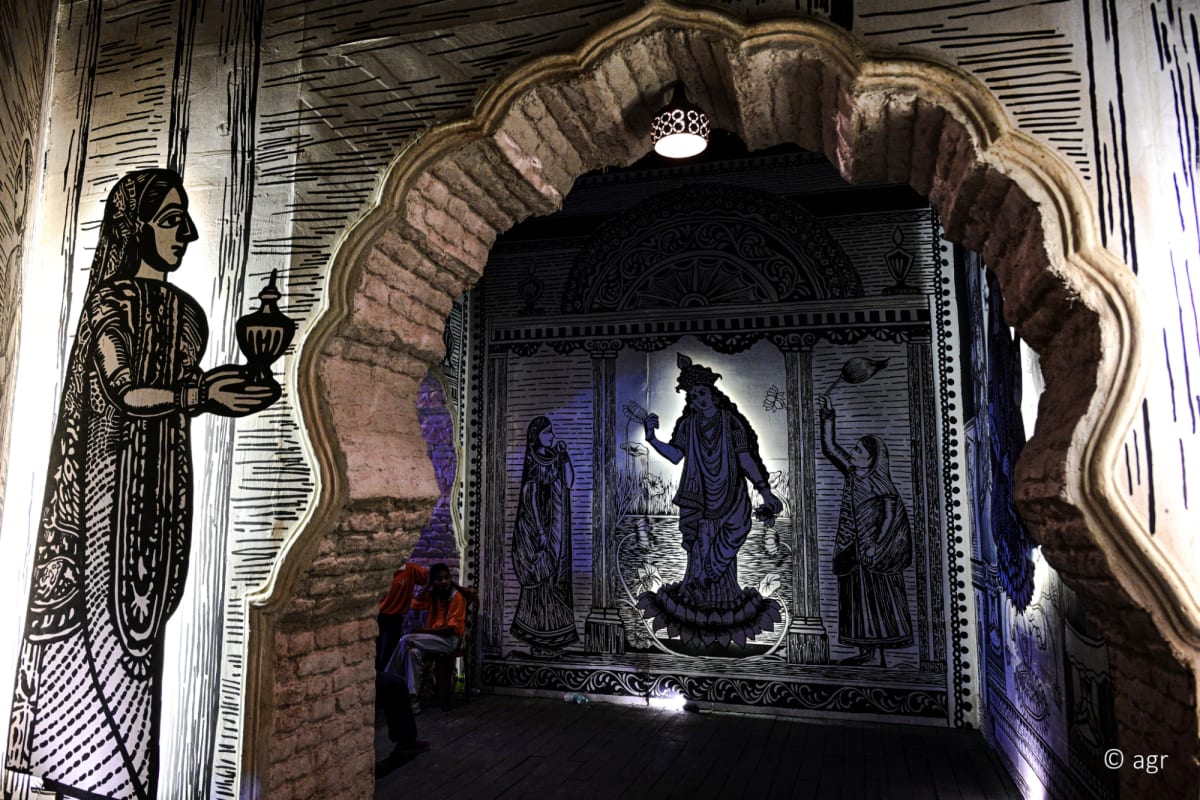
The mandap invites you into the world of the Bengali Panjika, the humble almanac that has long guided households on when to fast, feast, marry, and worship. Here, this printed relic is transformed into a walk-through installation. The visual language draws on old Battala woodcuts, with dense hatching, bold black motifs against pale backgrounds, and brick walls that appear almost printed onto the surface. Inside, time seems to wrap around you as installations trace the evolution of timekeeping and printing in Bengal.
Archways modelled on traditional brick thakur-dalans and old printing presses lead visitors through layered corridors, punctuated by life-sized illustrations of scribes and artisans. After this monochromatic world, the Goddess appears in a burst of colour. She is framed within a grand, multi-tiered dark wooden structure that evokes the architectural elegance of old Kolkata mansions and the frames of traditional printing presses.
Adorned in a radiant red sari with rich gold borders, Devi wears an elaborate silver-and-white tiara, complemented by understated ornamentation. The contrast is striking, bringing the installation’s intricate monochrome world to life.
Every wall becomes a page, every arch a turn of the leaf, and the mandap a thread connecting months, rituals, and myths in a story of how Bengal has long measured time.
Keep latched on to Avirup Guha Roy’s Blog and his SM handles for deeper insights into Durga Puja’s art and the often-unsung artists behind this extraordinary cultural phenomenon.