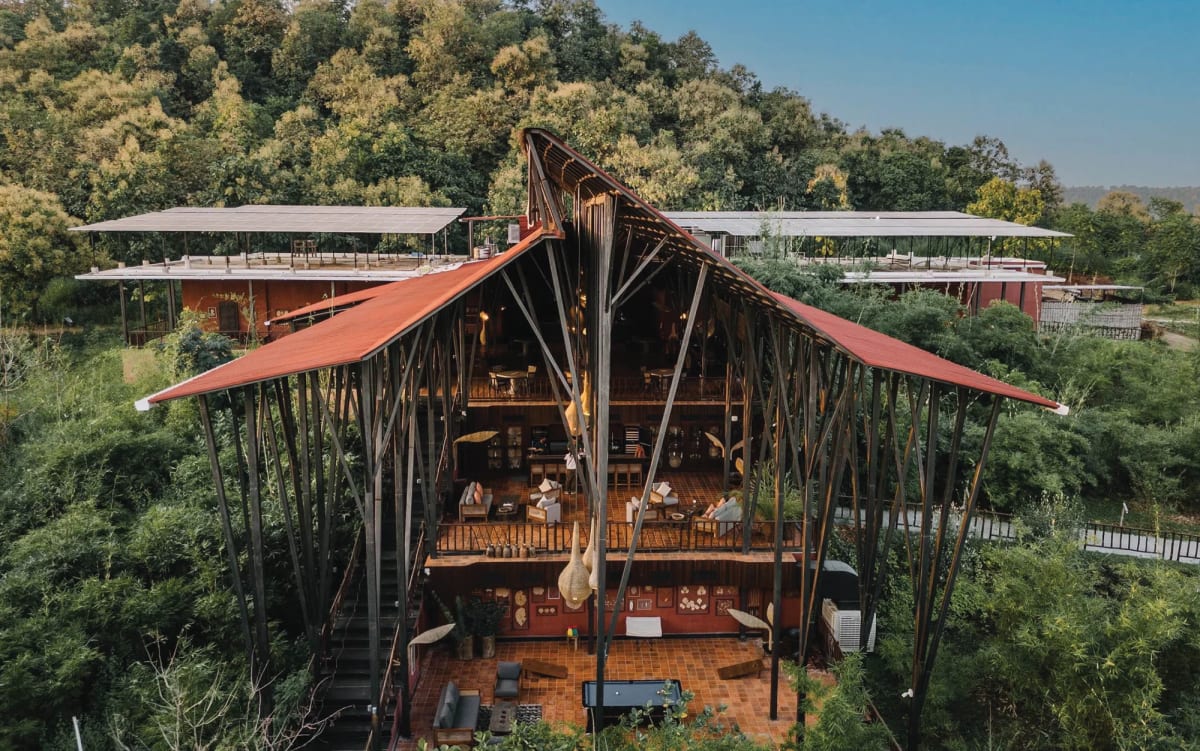
Three hours from Nagpur, our car entered a forested terrain. Dense bushes lined the path, and the only thing standing between me and the raw, untamed wilderness was a lofty 45-ft-tall pavilion built in steel, with a pitched roof that captures views of the horizon, its façade washed in earthen hues and handcrafted lights hanging like clusters of bulbul nests. Perch is the all-day, open-sided dining space at Tipai, and it feels less like a restaurant and more like a forest art installation.
Set across 38 acres on the fringes of Tipeshwar Wildlife Sanctuary, Tipai, a new wildlife retreat, is redefining the wildlife experience in India.
In April, the foliage had turned entirely golden. The air was dry, almost parched from the lack of rain. This dry spell in nature contrasts with the sense of holistic abundance that awaits within this microcosm. The true luxury here reveals itself at dawn, as you wake to the soft light of the forest slowly filtering through the trees.
A Forest Retreat Attuned With The Land
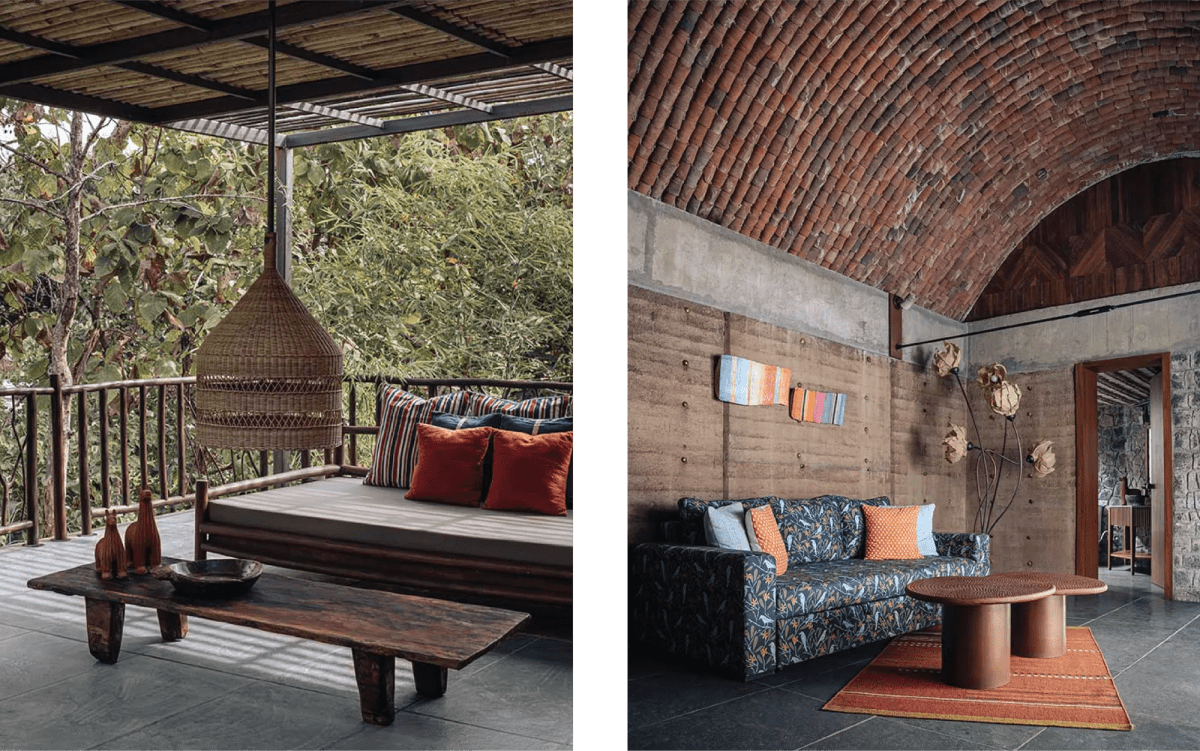
Nestled deep in the wilderness, the secluded forest villa, crowned with a vaulted terracotta-tiled roof, offers the first hint of where you are. Built in rammed earth with minimal cement and concrete, it seems to rise gently from the land itself. Silence engulfs the expanse around it.
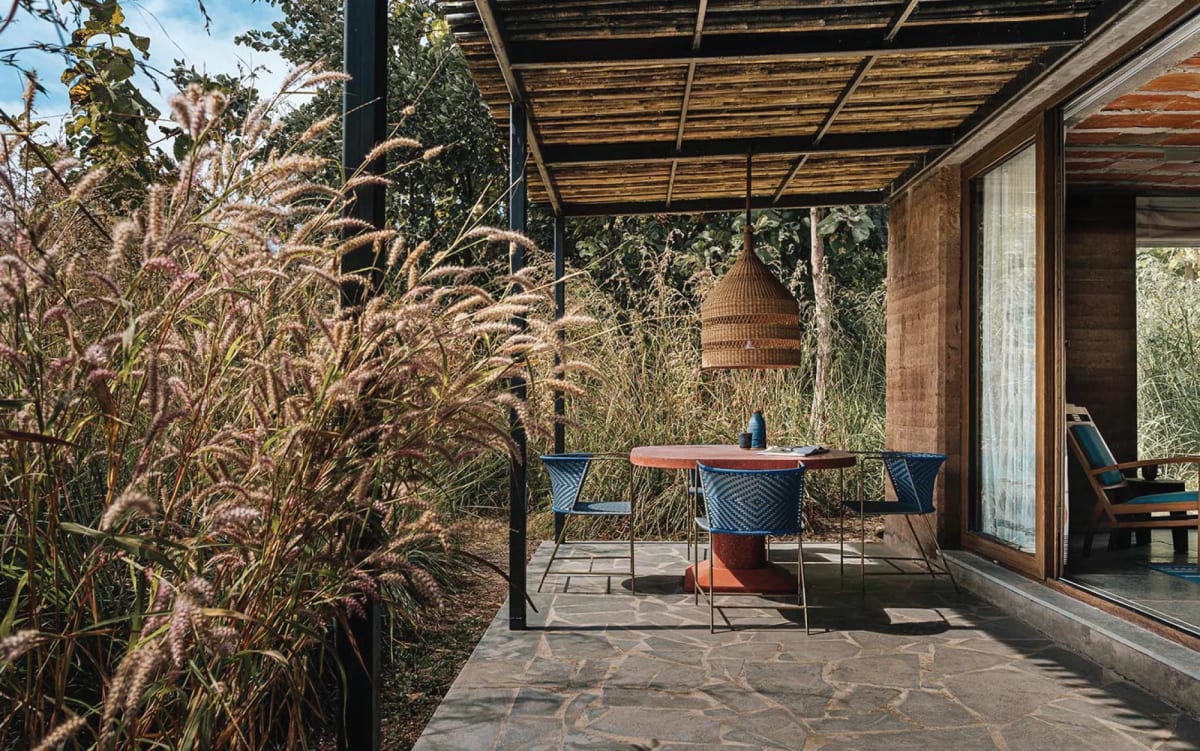
Open the bedroom’s floor-to-ceiling windows and the space spills onto a verandah with a lounger and a small private dining area, where the golden spikes of surrounding foliage almost gatecrash into the room. The property is completely unfenced, and on my first night, a thought quietly creeps in - there is plenty of room for a leopard to slip through the bushes.
Travelling solo carries its own quiet anxieties. At times, the curtains would stir, and the darkness outside seemed to peer in. The dense foliage felt like a cloak over the night, hiding something unseen. Sleep came only in fragments. The night stretched endlessly until my alarm finally rang. The moment it did, I was out of bed, dressed, and ready to head into the park.
Why Tipeshwar Wildlife Sanctuary For Spotting Wildlife?
At six o’clock, our jeep rolled through the forest gates, passing small villages along the way. Tipeshwar Wildlife Sanctuary is home to more than 170 species, including the Bengal tiger. I asked Rajesh, our naturalist, about the chances of a sighting. Given that sanctuaries usually have a lower wildlife density than national parks, I assumed spotting a tiger here might be unlikely.
As we ventured deeper into the forest, the landscape glowed with golden foliage. Sparse leaves clung to towering teak, while sandalwood and bamboo framed the dusty tracks. A grey-headed fish eagle perched above the water, and a wire-tailed swallow flashed past in a streak of blue.
Suddenly, a pack of wild dogs crossed the road with agile grace. A sambar deer looked up as we passed, then vanished into the trees. Moments later, its sharp, barking alarm call echoed through the forest, warning of a predator nearby.
Without wasting a moment, our jeep sped forward, kicking up a cloud of dust, as if we had struck gold in the forest. Soon we reached a clearing where a line of jeeps had already gathered, all jostling for position. A female tiger had been spotted. We were too far back, catching only fleeting glimpses, but nothing clear enough for a photograph. The young tigress had settled under thick bushes, perfectly camouflaged.
Rajesh, our naturalist, suggested we wait. The sun climbed higher, and the heat intensified. “She might cross the road to the watering hole for a drink,” he said. One by one, the jeeps began to disperse.
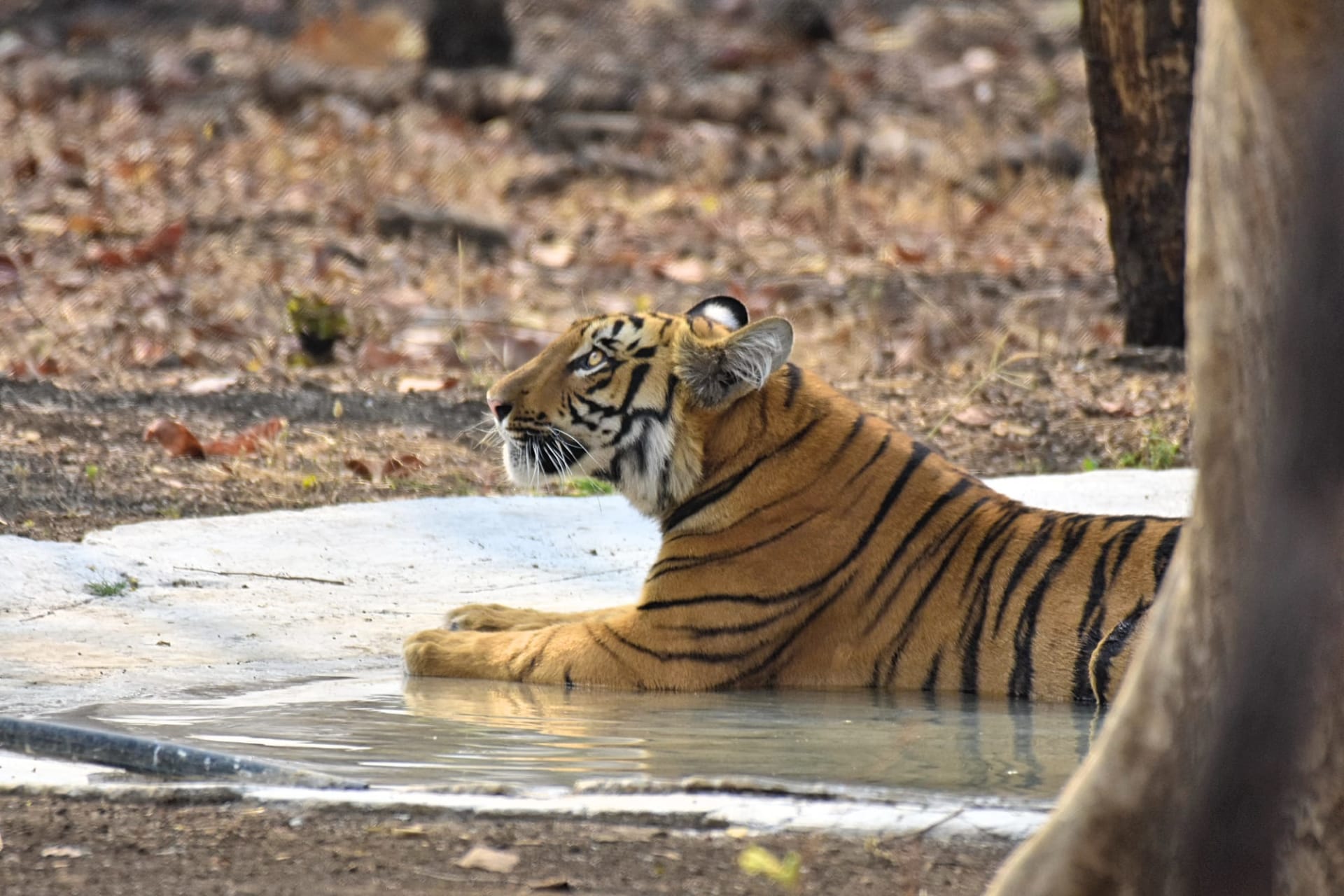
Then, with a slight movement in the bushes, her full form emerged. The tigress stepped out, unhurried. Daisy carried herself as though the forest were her private stage, pausing almost deliberately, as if offering us a moment for photographs.
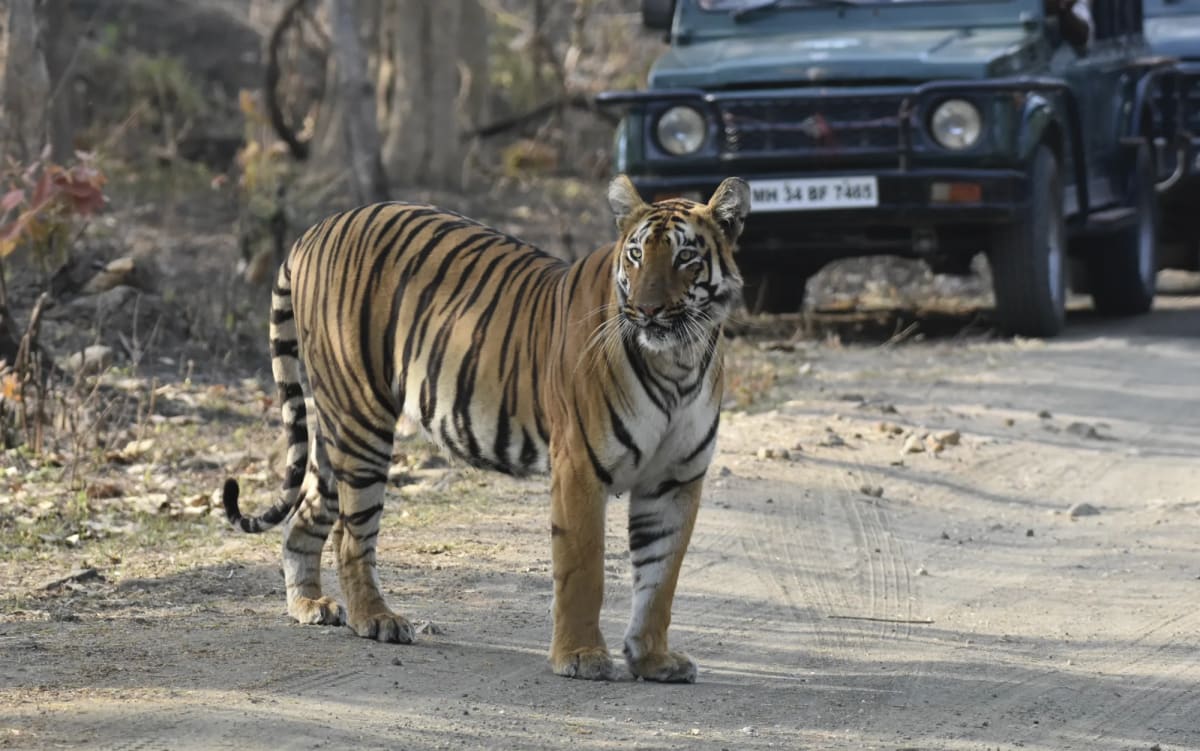
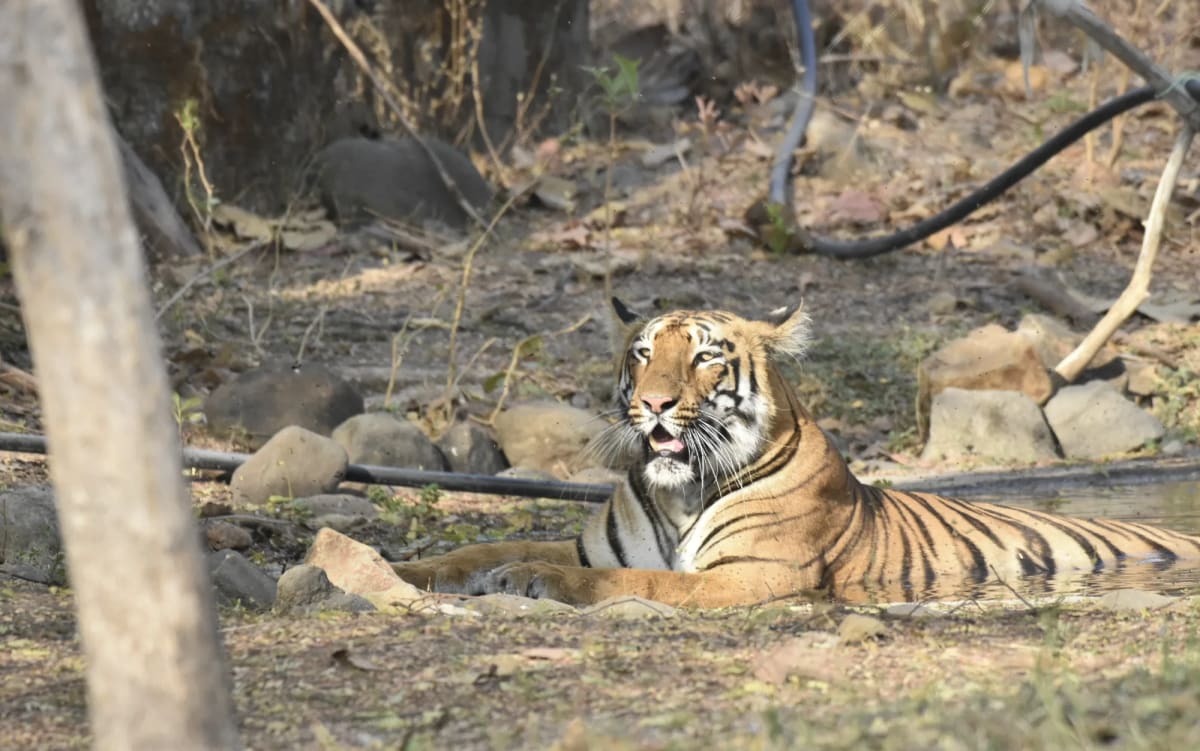
Unfazed by the vehicles, she crossed the road with effortless grace, walked to the watering hole, drank slowly, and then slipped into the cool water for a languid soak.
“Because the core forest area here is only about 140 square kilometres and is now home to more than 12 tigers, sightings are almost inevitable. Compared to larger national parks, it is a relatively small territory, and the big cats stray into nearby villages at times ”, Rajesh informs me to clear my delusion that wildlife sanctuaries are no destination for wildlife sighting.
The Path Of The Male Tiger
Soon, our driver received an update: a male tiger was on the prowl. We took a turn where the road narrowed, and the forest seemed to close in around us. From a distance, I caught a flash of bright yellow stripes moving through the trees. By the time we reached the stretch, the path was already packed with safari vehicles, leaving little room to move.
The tiger moved steadily along the trail. Within moments, the massive male came startlingly close to our jeep, striding calmly beside the track as we rolled forward, almost matching his pace. His face was enormous — broad, powerful, and intensely watchful — the most menacing tiger I had ever encountered in the wild.
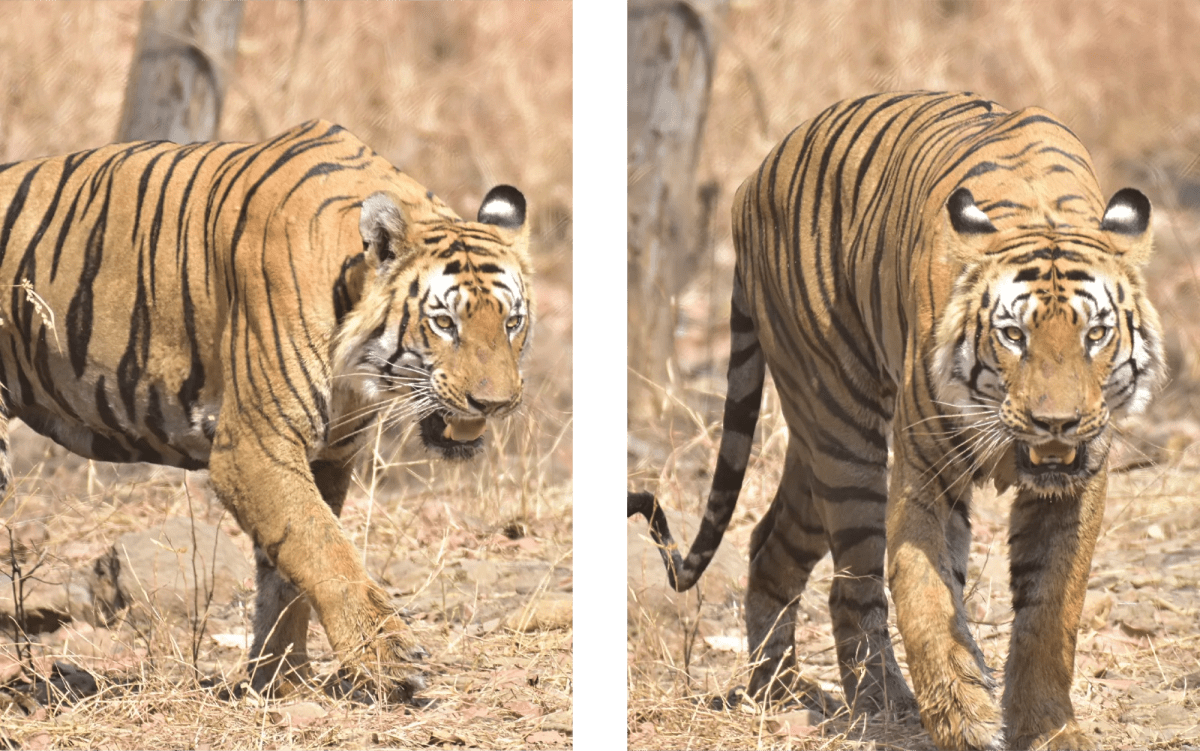
The tiger moved steadily along the trail. Within moments, the massive male came startlingly close to our jeep, striding calmly beside the track as we rolled forward, almost matching his pace. His face was enormous — broad, powerful, and intensely watchful — the most menacing tiger I had ever encountered in the wild.
Low growls rumbled from his throat, deep enough for us to hear, sending goosebumps down my spine. Guides whispered he might be searching for a female, perhaps patrolling the area in anticipation.
He eventually approached a watering hole, his expression now sharply focused — the look of a tiger ready to hunt even in daylight. When he paused briefly, the thrill was overwhelming. It was the moment that gave me the shot I wanted.
At Night The Forest Stood As A Kitchen
Nestled on the forest floor and surrounded by palash and bamboo trees, Palaash offers an intimate bush dining experience. The kitchen sits beneath the canopy, housed under a simple shade yet fully equipped. Cooking here is entirely gas-free, relying on ancient techniques — chulhas and sigri grills glowing through the evening. Chef Amninder Sandhu leads a team of local women from nearby villages, creating what is perhaps the first degustation-style dining experience of its kind in an Indian forest. At its heart is a community of women championing local ingredients, reviving forgotten techniques, and crafting a fine-dining experience rooted in hyper-local Indian recipes.
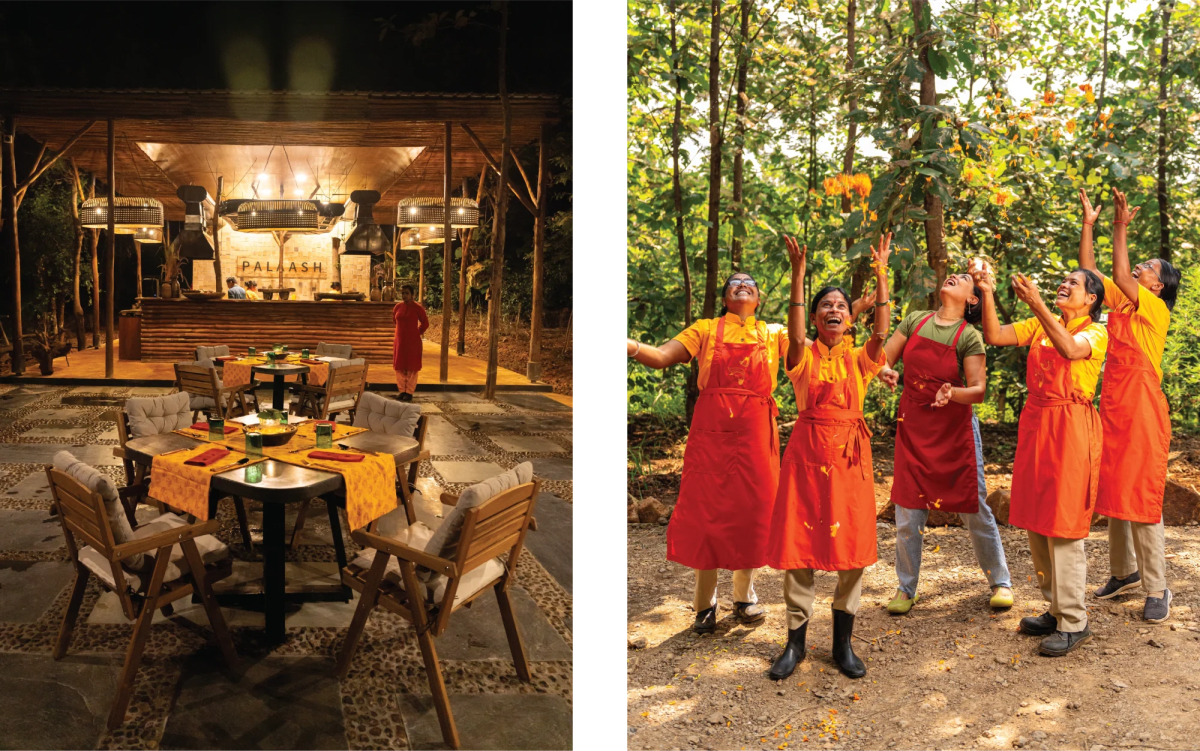

I stepped into the kitchen to watch the preparations. In an earthen pot, Indrayani rice — a local variety often compared to sticky jasmine rice — steamed gently in banana leaves. Nearby, mutton is slow-cooked inside a bamboo cylinder over glowing embers. When it arrived at my table, the meat fell apart effortlessly, rich with the deep flavours of masala. Paired with the aromatic Indrayani rice, the dish felt unexpectedly comforting.
As I reached the final course — a baked kala jamun soaked in mahua syrup — a quiet realisation settled in. This fine-dining experience, perhaps the first of its kind in India, celebrates the bounty of the forest. In the candlelit glow, surrounded by towering trees, the wilderness felt impossibly close. And for a fleeting moment, a thought crossed my mind — what if a pair of eyes in the darkness suddenly began watching me?