Every marriage has its twists and turns. In my naivety and love, I assumed our one-time-ticketed adventure ride in Dubai, UAE, would be our only turbulence. The ride involved a dramatic drop from more than 50 feet. Little did we know that our next adventure would take us to the Himalayas, all the way to Bhutan!
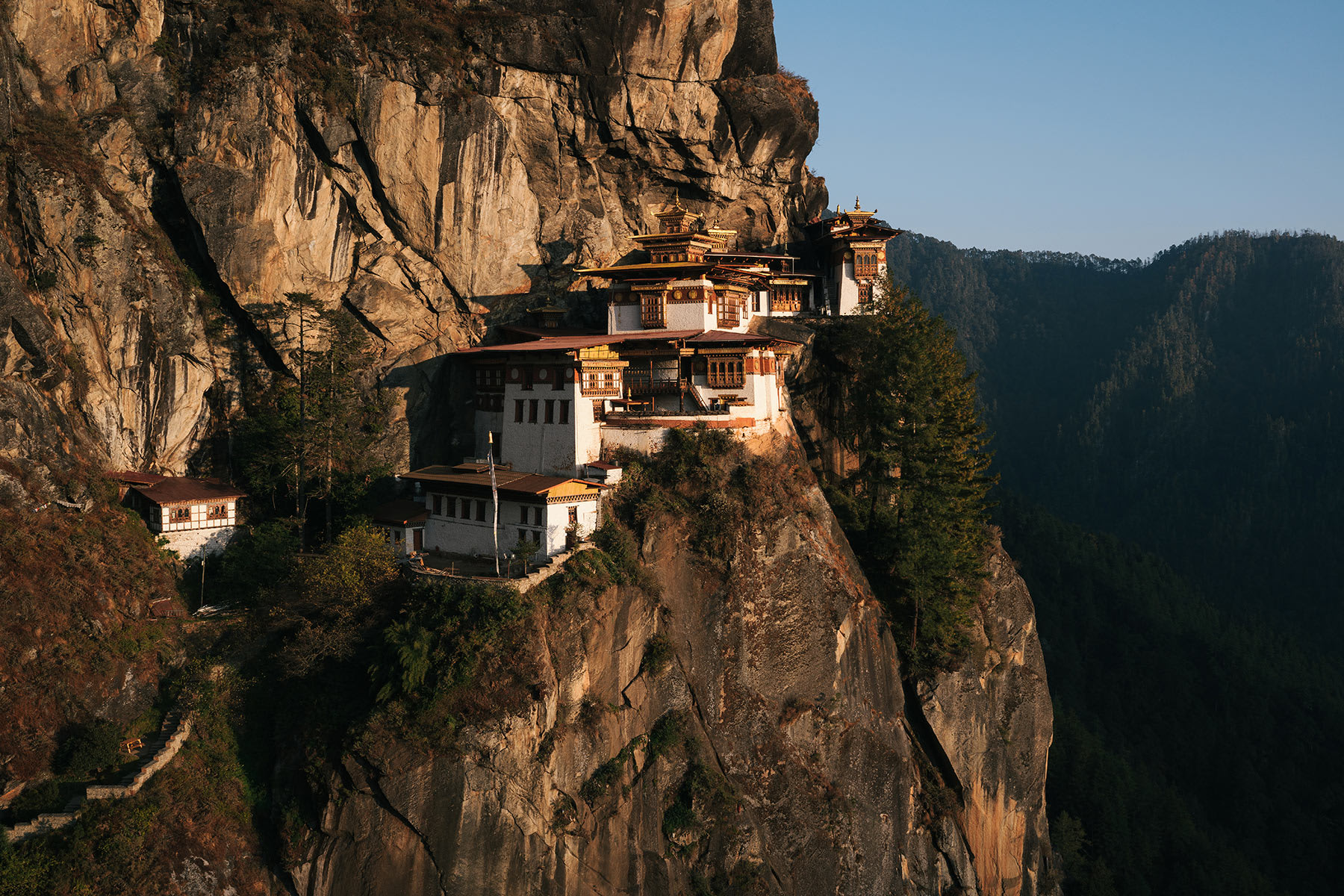
Young at heart and often on our knees, we soon discovered that Bhutan came with its own caveats: unpaved roads that had clearly lost an argument with nature, and flights of stairs at almost every tourist site. Then came the courage to try Ema Datshi, Bhutan's fiery chilli-and-cheese national dish. And then there was a legend. In the 8th century, Guru Rinpoche is said to have flown from Tibet on the back of a tigress, seeking refuge in a rocky cliff nearly 10,000 feet above sea level. Today, that sacred perch is known as Tiger's Nest, or Paro Taktsang, a monastery seemingly suspended from the mountainside and a bucket-list pilgrimage for trekkers around the world. Naturally, we decided to make that sacred ascent together.
The Numbers Behind The Climb
Because I had decided to rely on numbers on this adventure, here is some maths. Bhutan’s Gross National Happiness Index spans nine domains. ‘Tiger’s Nest’ promised a 6-8 km round trip and an elevation gain of approximately 520 metres. The monastery stands 10,000 feet above sea level. And well, the chilies, depending on variety, rank between 30,000 and 50,000 on the Scoville Heat Scale!
With all this data, my partner and I should have known better.
At the trailhead, our 20-year-old guide estimated that we would be back by dinner. Confident, we suggested lunch. No spoilers – we returned by evening, bones intact and ready for ‘Ema Datshi’, red rice, momos and ‘Ara’ (alcoholic drink made by fermenting and distilling grains like maize, barley, wheat, or buckwheat). We had also carried a Canon 5D Mark II, weighing approximately 1.5 kg with its lens, to document our adrenaline-fuelled romance amidst nature.
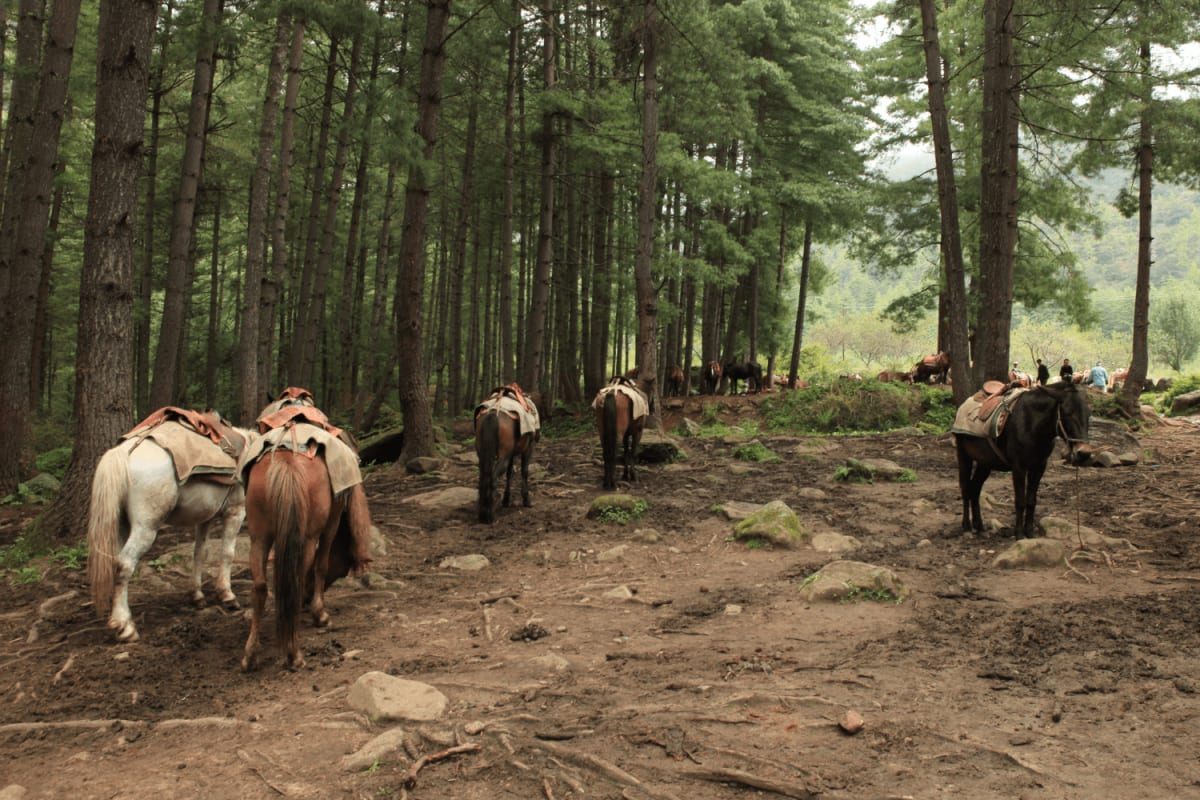
On a cloudy September morning, we stood there, unaware of the precautions we needed to take until our guide warned us. He assured us that the rain would hold off until night, with the ease of someone who calls nature home. Horses and mules tempted us, but they travel only roughly halfway up and operate uphill only. So, we let them rest. Our guide suggested silencing our phones before leaving us to the whispers of nature and the sustained forest ascent. He said he would join us later, which we assumed meant dinner.
September’s retreating monsoon had left the trail intensely green, damp, and occasionally wrapped in mist. Blue pine, oak, ferns, moss, and lichen crowded the softened soil and draped themselves over trunks, stones, and exposed roots.
A Forest Full of Legends
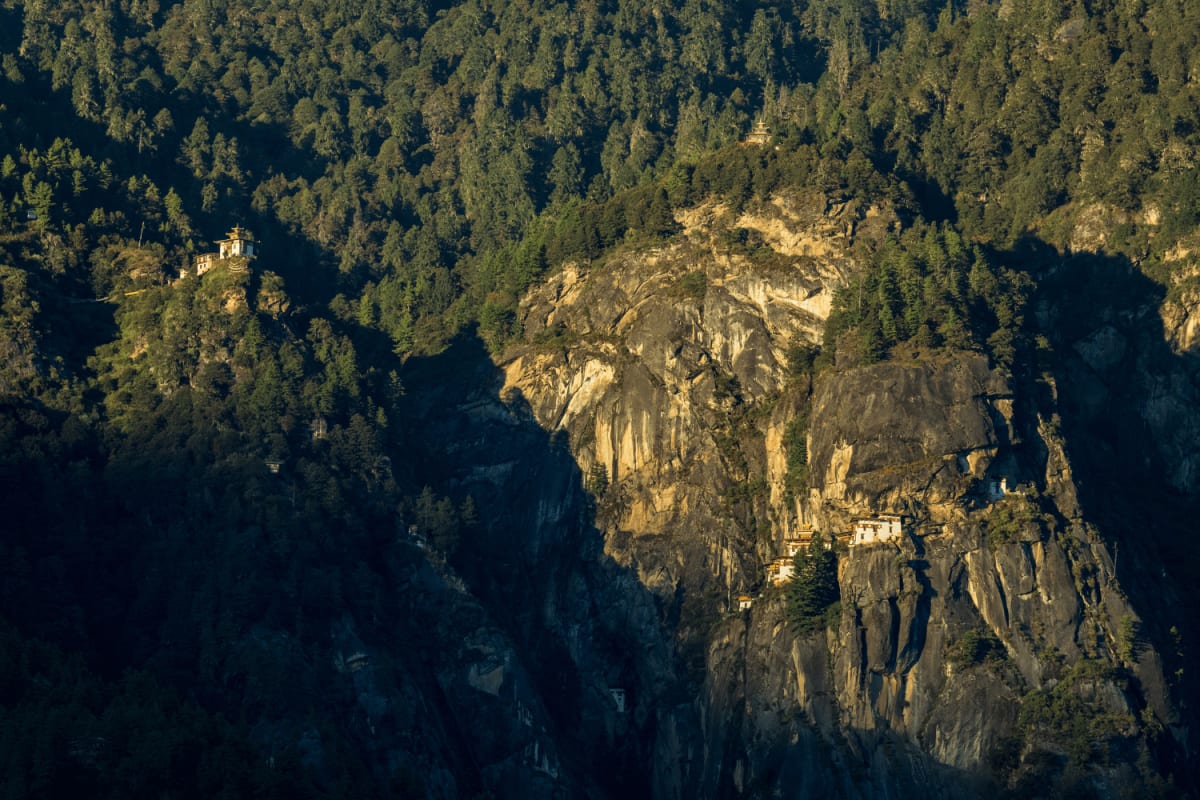
We pinched ourselves as we looked up at ‘Tiger’s Nest’, first built in 1692. Our imagination failed us when we considered the logistics of its construction. We happily eavesdropped as a local recounted the legend. The site marks the cave where Guru Rinpoche is believed to have meditated in the Eighth Century. Legend says he arrived on the back of a flying tigress. The tigress was no ordinary big cat. According to legend, she was Guru Rinpoche’s disciple, Yeshe Tsogyal, in transformed form. Clearly, horses were not the only ones to avoid the climb in those days!
Dogs ran across the trail, and we gave way, reminded that the Buddhist principle of ahimsa discourages harm to sentient beings. Between breath-catching stops, we heard an opera of birds; signs identified 33 resident and migratory species along the trail. Our camera was already loaded with images of the site from afar.
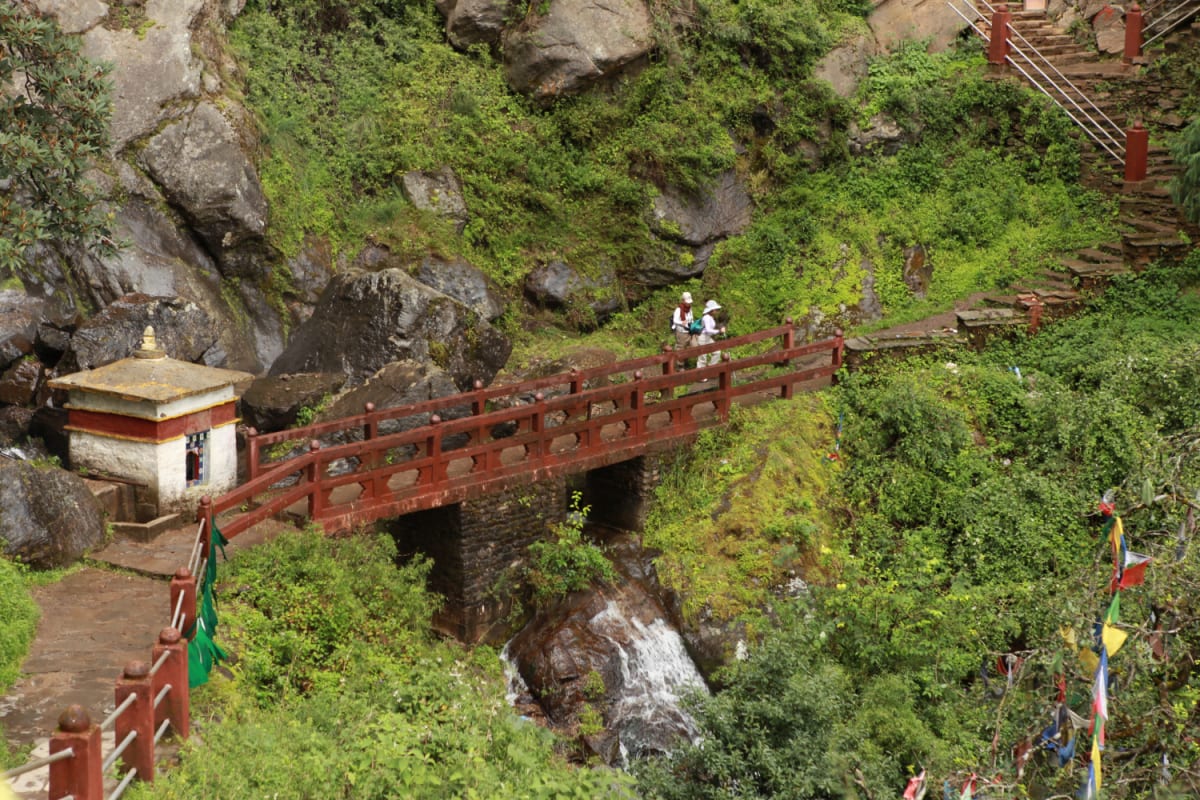
Whilst the path carried us, the winds carried peace. Prayer flags in blue, white, red, green, and yellow brightened the largely green palette. The wind is believed to carry their prayers across the landscape, while their gradual fading reflects impermanence.
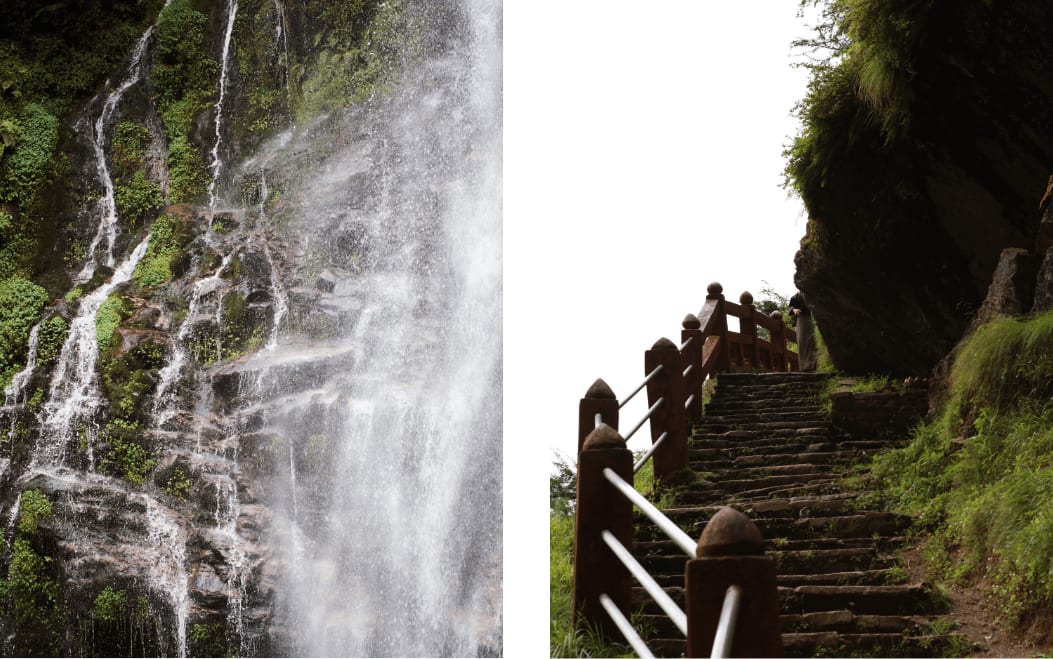
With shortness of breath now a common thread, we felt the first signs of the trek reaching our glutes. We arrived at the cafeteria and rest point, followed by the iconic viewpoint opposite the monastery. Beyond it, we descended into the ravine, crossed the waterfall bridge, and began the final climb. We paused every now and then to admire the water-loving vegetation and the wooden railing running alongside the foliage-rich path.
When The Mountain Humbles You
Our faces gave away a question we did not have to mouth. Did people really do this daily, carrying necessities and more? Four men passed us, carrying what looked like a transformer on a makeshift wooden bed. Twice our age and moving at twice our pace, they smiled at our expressions. One told us to buck up. He then called back that going “faster would bring disaster.” We were reminded of the messages painted along Bhutan’s roads.
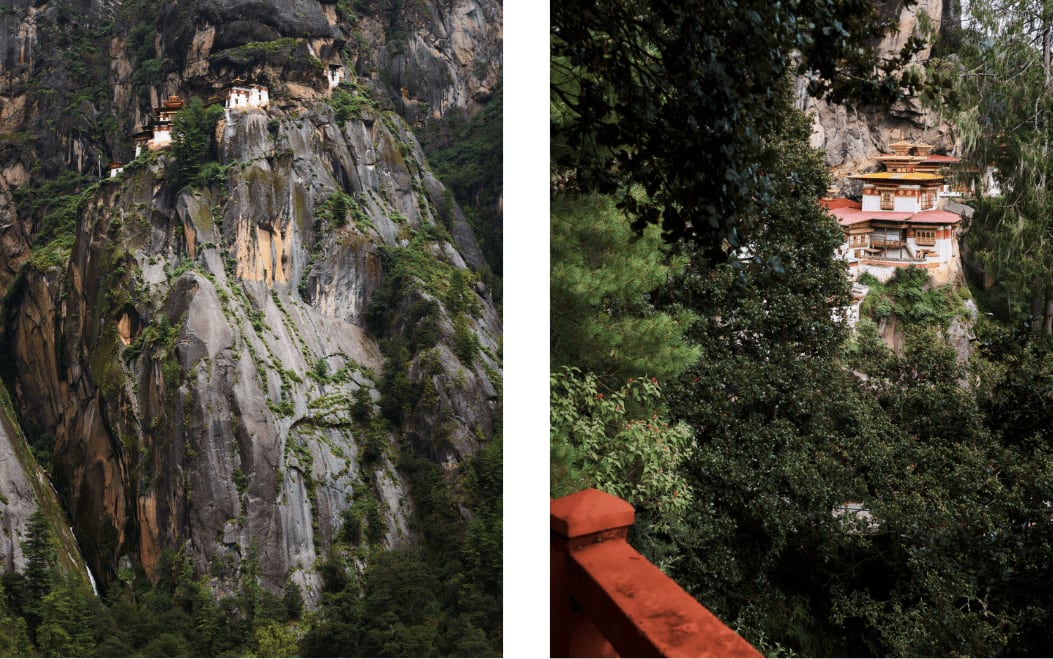
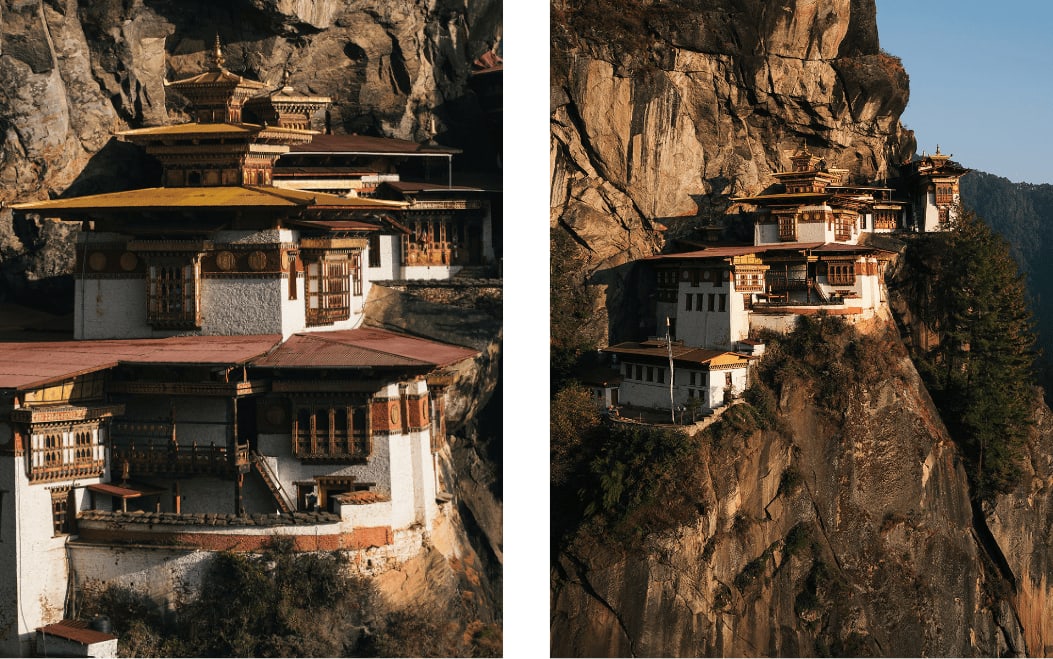
The view ahead was a zoomed-in version of what we had seen below. This one, we had earned at every step. After depositing our cameras, phones, and bags, we entered a cliffside complex of whitewashed walls, carved balconies, and golden roofs. Smaller chambers and monastic dwellings occupied different levels of the rock.
Its four principal temples contained statues, murals, thangkas, and sacred texts. The central prayer wheel, traditionally turned by monks at the start of the day, was worth the trek alone. The sacred cave associated with Guru Rinpoche is highly restricted and opens to the public only on special occasions. Monks moved quietly through the tourist crowds; we lit a butter lamp and found faith in its guiding light.
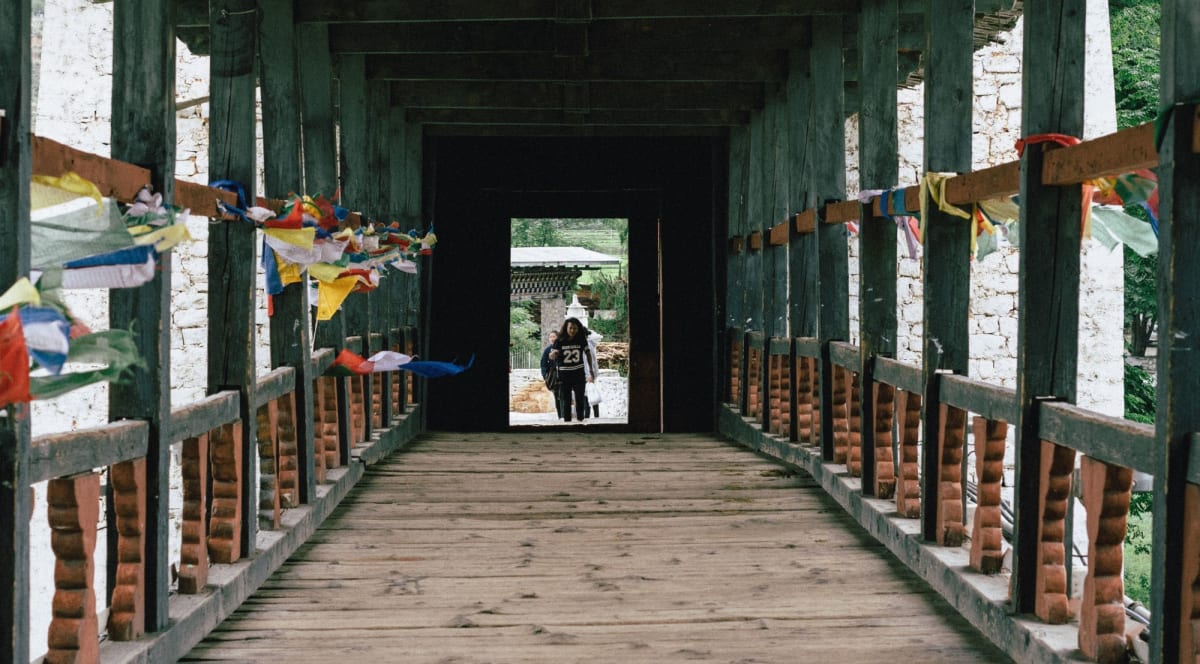
The adage that it is the journey, not just the destination, demanded an edit. This trek showed us that both mattered. Within minutes, we had forgotten the steep steps, uneven paths, and constant awareness of the height we now had to descend. Our bodies were calmer, even if exhausted. Somewhere between hours six and seven, we spotted our guide humming to himself, as if the only thought on his mind was: It’s a beautiful day for a short stroll!
Strangers had offered us jackets, trekking poles, water, and even medication, if required. We had burnt off the calories and perhaps a few tension lines too.
At dinner, rain began tapping against the window, exactly as our guide had predicted. The five-hour trek had taken us eight; our knees protested, but our marriage remained intact. A road sign we had seen—“If you are married, divorce speed”—no longer sounded like mere safety advice.
For one day, happiness was uncountable steps achieved sans an app, muddy clothes, two aching bodies, and the knowledge that we had made it back together.
A Trek To Tiger’s Nest, Paro | TH Recommends
As one of Bhutan’s most iconic trekking trails, Tiger’s Nest is worth the climb for its breathtaking Himalayan views and the enchanting legends woven into its history. Planning your next Bhutan adventure?
Travel Handmade brings you three recommendations to make the most of this unforgettable journey:
1. Experiencing Bhutan with a Luxury Hike to Tiger's Nest (hosted by Walk into Luxury)
2. A Hike to Magical Taktsang, Bhutan (hosted by Wilderness Travel)
3. A Cultural Immersion at Taktsang Monastery (hosted by Breathe Bhutan)